 |
| ze zbiorów własnych, Oaxaca, Meksyk, 2011 |
Dzień zmarłych ... nawiązując do daty w kalendarzu, przybliżę sylwetkę pewnego artysty. Jak wiadomo polski dzień zmarłych oraz dzień zaduszny (1-2 listopada), znany w pewnych częściach świata jako skomercjalizowane Hallowen (tradycja algo-saska, 31 października) ma również odpowiednik w niektórych krajach ameryki środkowej i południowej jako Día de Muertos. W tym miejscu muszę dodać, że oba te święta pomimo zbieżności w dacie mają inne korzenie ponieważ Hallowen wywodzi się z tradycji celtyckiej jako święto wiedźm i czarownic w przeciwieństwie do Dia de Muertos. Meksykańska tradycja jest pozbawiona elementu grozy, a nawet smutku, stanowiąc czas hucznych zabaw i biesiad dla wszystkich członków rodziny, w tym żywych i zmarłych.
 |
| ze zbiorów własnych, Oaxaca, Meksyk, 2011 |
Día de Muertos jak podają źródła jest uznawane za najstarsze w Meksyku święto etniczno- religijne, sięgające swymi korzeniami około 3000 lat wstecz.
Obecnie obchody poza Meksykiem, szerzej, Ameryką Centralną, niekoniecznie odzwierciedlają tradycyjne elementy; podobnie do sytuacji z Halloween, zachodzi tu sporo dowolnej interpretacji o charakterze artystyczno-rozrywkowym. Festiwal, z którego wywodzi się obecny Dzień Zmarłych, odbywał się podczas 9. miesiąca kalendarza słonecznego Xiuhpohualli Azteków – miesiąca zwanego Tlaxochimaco (narodziny kwiatów), wypadając na początek sierpnia, a trwał przez cały miesiąc. Festiwal był w gestii bogini Mictecacíhuatl, żony boga Mictlantecuhtli, Władcy Krainy Zmarłych, znanej jako "Królowa Śmierci" (obecnie związanej z wizją postaci "la Catrina". Obchody skupiały się, podobnie jak i dziś, na czci dzieci i drogich bliskich, którzy odeszli.
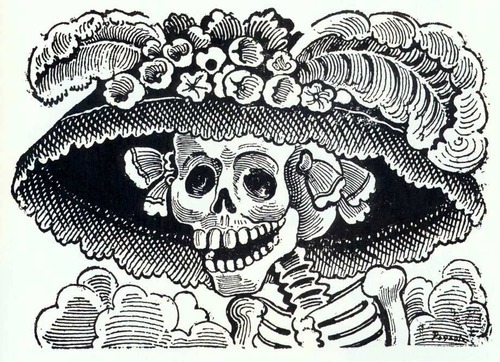 |
| La Catrina, José Guadalupe Posada |
José Guadalupe Posada, an ingenious artist, lived during one of the most turbulent times in Mexico. He knew how to capture the essence of this turbulence in his lithographs to the point that they became the icon of Revolutionary Mexico.
Posada was born in Aguascalientes in 1853, and as a child, he learned the techniques of grabado and lithography in Trinidad Pedroso’s Workshop of Popular Graphics. In 1871, he began to collaborate as an illustrator for El Jicote, which was published in his native land, where his sarcastic style had already begun to emerge.
It’s possible that because of political persecution he was forced to move to León, Guanjuato, where he gave classes at a high school. There he built his own workshop and quickly became famous in his field.
 He moved to Mexico City in 1888 and began 25 years of lithographic and “grabado” production, collaborating for several newspapers and flyers. In all of these cartoons, Posada satirized governmental abuses and revealed all different types
 of secrets and gossip about the families favored by the Porfirista regimen (the period when the Mexican dictator Porfirio Díaz rules). Posada immortalized both important events and everyday life in his work, but not only that...
Posada gave it a face, with a sarcastic, ironic touch. It was through his art that the Catrina and later the Calaca were born. The Catrina Both feminine personalities are famous icons of death and the top creations of Posada.

*Catrina : Spanish word that means well dressed, rich. Posada used it as a way of criticizing the rich society of Mexico.
http://www.inside-mexico.com/posada.htm
Cytat artysty:
"La muerte, es democrática, ya que a fin de cuentas, güera, morena, rica o pobre, toda la gente acaba siendo calavera".
[Śmierć jest demokratyczna, bo przecież na koniec blondynka, brunetka, bogaty lub biedny, wszyscy ludzie kończą jako czaszka]
[Śmierć jest demokratyczna, bo przecież na koniec blondynka, brunetka, bogaty lub biedny, wszyscy ludzie kończą jako czaszka]
Nawiązując tematycznie wrzucam jeszcze animację z zaświatów ;P

Calavera para Ewa
ReplyDeleteEstaba Ewa parada
comiendose una paella
cuando llega mi tia la huesos
... a quererla llevar con ella
Ewa brincó de espanto
su suerte ya estaba hecha
pues a la dama de blanco
no le gusta que le den frescas.
Muerte aún no me lleves
le dijo Ewa a la calavera
aún no vuelvo a México
a bailar con su gente tan bella
Bailamos tu y yo un tango
le dijo la dama compuesta
en el camino al camposanto
una rosa adorará tu testa.
Ya Ewa está descansando
La catrina la llevó con ella
y pronto estará bailando
con Gardel "Por una cabeza"